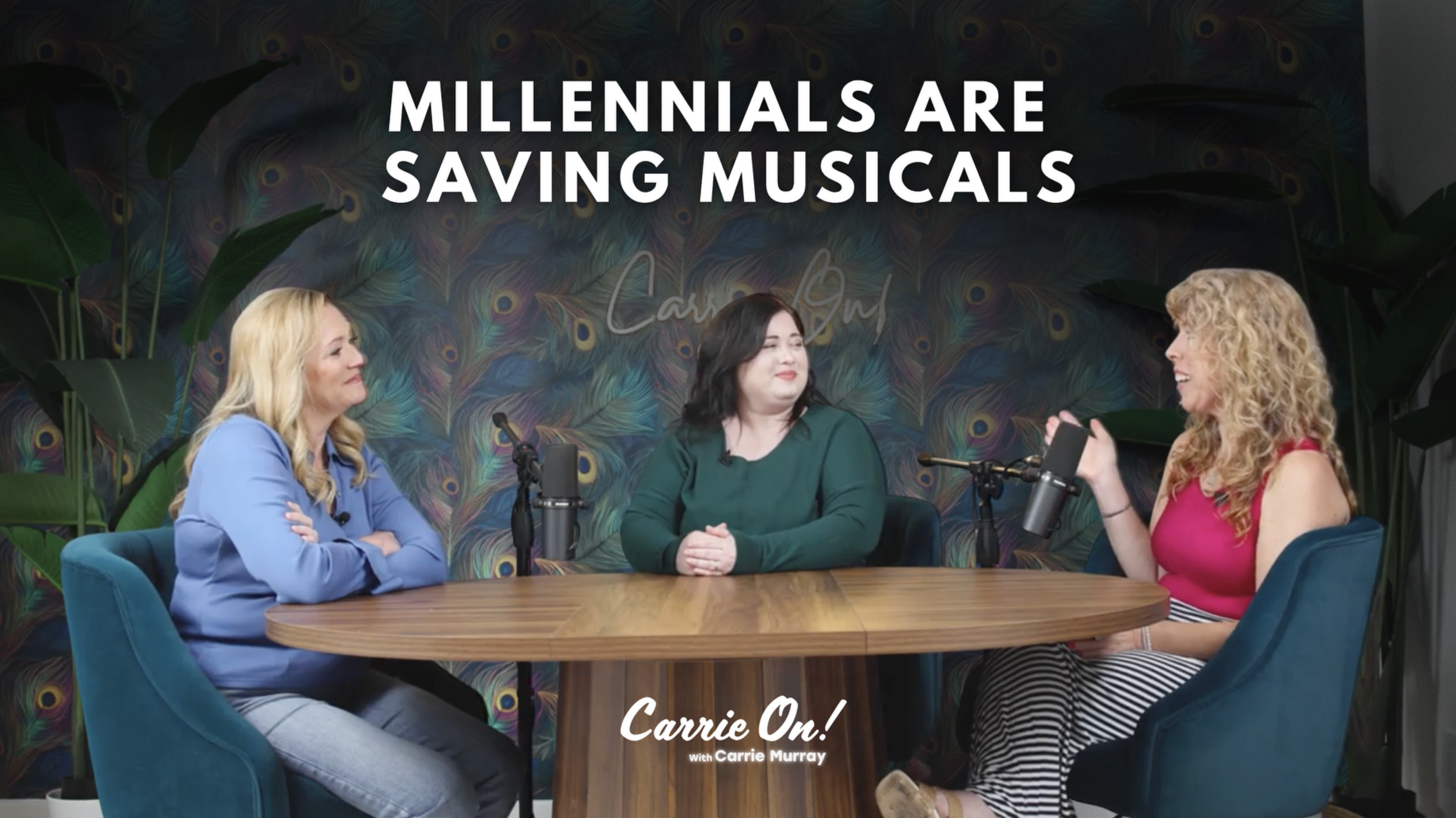
Who Gets to Tell the Story? Inside Broadway's Next Act with Nico Juber & Kristin Hanggi
If you've ever left a musical still humming the songs three days later, this episode of Carrie On! is for you.
I sat down with two women who are quietly (and not so quietly) reshaping musical theater: Nico Juber, the writer behind the original musical Millennials Are Killing Musicals, and Kristin Hanggi, the Tony-nominated director of Rock of Ages and Netflix's Julie and the Phantoms. What started as a conversation about a new show turned into something bigger — a real look at who gets to stand in the writer's room and the director's chair, and why that matters more than we think.
The stories that raised us
Kristin told me about the first time she saw a musical as a kid — her older brother in a production of Our Town — and how she sobbed so hard at his character's death that her mom had to carry her out of the theater.
That's the kind of spell theater casts on us before we even understand what we're watching. She was staging her own living-room productions and charging her parents admission not long after. Nico's path looked different — she grew up around musicals literally at the dinner table (her grandfather created Gilligan's Island and The Brady Bunch, her father is a Grammy-winning guitarist) but didn't let herself claim "writer" until a cancer diagnosis in her twenties and a decade in corporate marketing pushed her toward the piano.
That's the thing about this episode — it's not just industry talk. It's about the permission we give ourselves, or don't, to do the thing we were built for.
Millennials Are Killing Musicals

Nico's musical follows three moms — a stifled single-mom creative, her pregnant influencer sister, and a woman who's lost her identity to motherhood entirely — as they untangle who they are underneath the pressure to perform online and off. It's funny. It's frothy. And underneath it, Nico is asking a real question about what social media is doing to a generation of women who are already being told they're the problem.
We also talked about why nearly every major opportunity for this show has come from women — artistic directors, producers, funders — and what that says about who's actually building the next era of theater.
The part nobody puts in the Playbill
Kristin didn't recognize herself as a director until a professor said it out loud in college — because somewhere in her head, "director" meant "man." She talks candidly about noticing, once Rock of Ages hit Broadway, that she was almost always the only woman in the room, and how that observation traced all the way back to systemic efforts to keep women out of directing going back a century. We get into the pay gap, the impossible tightrope of being a powerful woman who's still expected to be "likable," and whether Broadway's ticket-price model can survive as it prices out the very audiences who show up to buy the tickets in the first place.
And then there's Winter
Nico also opened up about her other musical, Winter — an original show about a bisexual teenager coming out during her senior year of high school in 1999. It's joyful, it's got a Total Request Live countdown structure, and it was written specifically because she and her co-writer couldn't find representation for bisexual characters that wasn't rooted in trauma. The most moving part of our conversation: after a high school production of the show, several students came out to their own families, inspired by what they'd just been part of.
Press play
We close things out the only way two theater kids know how — a top-five musicals showdown that doubles as a personality test (Hedwig, Company, Ragtime, and Rocky Horror all make appearances).
If you love musical theater, or you've ever wondered why the stories that shape us get made by the people who make them, this is a conversation worth your ears.
Listen on Apple Podcasts orSpotify.
Prefer to watch? Head to YouTube.
Keep your head above the chaos, and Carrie On!
— Carrie